
5 Dog Safety Rules Every Kid Should Know
Think about it this way: not every person is friendly, and even friendly people aren't friendly all the time.
We all have days when we want space, when we're not in the mood, when someone gets too close and it just doesn't feel right. We respect that in people without thinking twice. We read the room, we don't force a hug on someone who looks uncomfortable, we give people their space when the moment calls for it.
Dogs are exactly the same.
They have their own personalities. Their own moods. Their own boundaries. And just like people, they have ways of saying "not right now", we just have to know what to look for. Teaching kids to recognize and respect those signals isn't just about safety. It's about treating every dog the way we'd want to be treated ourselves.
Whether your family has a dog, your neighbor does, or your child meets one at the park — these five rules are a good place to start.
1. Ask First
Even the friendliest dog has off days, just like people. Before your child goes up to any dog, familiar or not, teach them to ask the owner first. If the answer is no, that's the whole answer. Say thank you and move on.
The owner's yes only means maybe. The dog gets the final say, and that's what the next four rules are for.
One more thing kids can learn to spot: a yellow collar, leash or vest, especially one that says ASK FIRST or GIVE ME SPACE, means that dog is asking for extra room.
Here's what yellow dog gear means →
2. Let Them Come
Teach your child to stand still and let the dog come to them. Dogs talk with their bodies, so this is the moment to watch:
Loose body, soft eyes, wiggly tail: the dog is probably happy to say hi.
Stays put, turns away, goes stiff, flat ears or tucked tail: the dog is saying "not today." That's an answer too.
More on reading a dog's body language →
3. Offer Your Hand
If the dog comes over, have your child hold out a loose fist, low and still, for a sniff. That small step lets the dog decide whether it wants to say hello, and it sets the whole meeting up for success.
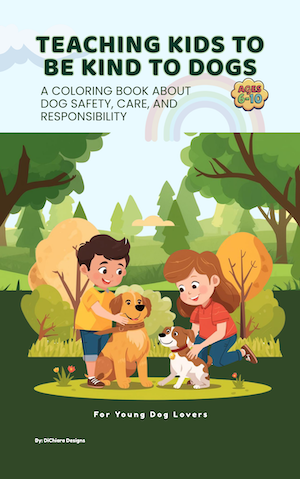
From Teaching Kids to Be Kind to Dogs. Available on Amazon and as a printable PDF on Etsy.
4. Gentle Touch
If the dog leans in, a slow, gentle pet is the way to go. No pulling ears. No grabbing tails. No chasing, climbing or startling. Even when a dog puts up with rough handling, it doesn't mean the dog likes it. If the dog moves away, stop.
5. Give Them Space
When the dog walks off, the hello is over. Some moments call for extra room:
Eating, sleeping or caring for puppies. A dog at its bowl or in its bed needs to be left alone, no exceptions. Even a patient dog may react when startled there.
When a dog seems upset. If a dog growls, barks or seems scared, the instinct is to run, but running can trigger a chase. Teach kids to stop, look away and back up slowly and calmly.
How do you teach kids to ask before petting a dog?
Practice at home with a stuffed animal before you meet a real dog. Ask the owner first. Then let the dog answer. Walk through all five rules: ask first, let them come, offer your hand, gentle touch, give them space. Once the steps feel easy at home, they come naturally when a real dog trots up.
These five rules are simple enough for a six-year-old and meaningful enough to last a lifetime. Dog safety isn't about fear, it's about respect. And kids who learn to see dogs through kind eyes tend to grow up kinder for it.
Want something to put on the fridge?
Download the free Dog Safety Activity Pack: a printable set your kids can actually use.
It includes:
a Dog Safety Guide
a Dog Care Checklist
and a Reward Chart
All three are free.
Want to go deeper?
Teaching Kids to Be Kind to Dogs is a coloring book for kids ages 6–10 built around kindness, safety, and empathy, one page at a time. Also available as a printable PDF on Etsy.
Or grab the Teaching Kids to Be Kind to Dogs Activity Pack: 10 activity pages that bring the book to life, available on Etsy for $4.99.
Also part of the Be Kind series: Be Kind to Animals, teaching kids empathy toward all animals, one page at a time.